Key Takeaways:
In an industry full of intermediaries, most cosmetics brands scale through wholesale. FIRN, a new French performance skincare brand, is taking an opposite path, breaking the rules of the beauty playbook. Shortly after launching online at the end of 2025, the brand opened two stores in Paris, with an aim for further expansion. By controlling distribution, the brand’s founders chose to focus on their own network of highly differentiated experiences, where design and services are rooted in science rather than marketing.
A Direct Approach to Brand Distribution
To explain what drove the founders of FIRN to immediately start with their own retail footprint, we must first understand how the brand came to be. Sacha Bostoni, co-founder of successful eyewear retailer Jimmy Fairly, first met scientist Fred Zülli nearly three years ago. Dr. Zülli , an award-winning Swiss expert on cosmetic biotechnology, is vastly known for his pioneering work in natural stem cells. It was Dr. Zülli’s scientific research on plant stem cell biotechnology that inspired Bostoni with an idea. “I thought it would be interesting to explore how to democratize access to these exceptional sciences that are usually found in luxury products,” he shared with BeautyMatter. His vision was influenced by the experience and success of his eyewear brand: Jimmy Fairly, launched in 2012 as a direct-to-consumer brand offering affordable luxury styles, thanks to a wholly disintermediated model. It now has over 160 stores across Europe.
For two years, Bostoni worked with Dr. Zülli to develop an innovative formula exclusively for FIRN. This resulted in a patented STM30 complex, a unique blend of two biotechnologically derived active ingredients: alpine plant stem cells and glacial microorganisms. From there, Bostoni reached out to Raphaële Four and Clémence de Stabenrath, who had respective expertise in branding and product development and became co-founders on this venture.
With two decades of experience launching and expanding a brand with its own store network, Bostoni set out to do the same with the skincare industry.
“What struck me early on is that there are very few performance-driven brands with their own retail network. The Ordinary has some stores, and there are a few others, but overall it’s quite rare,” Bostoni pointed out. In the US or UK, brands such as Aesop and Malin + Goetz took this route, but it is much less common in France, where most skincare brands are sold mainly in pharmacies or multibrand specialty retailers.
Rolling out brand-owned stores was a non-negotiable for Bostoni. He explained, “I can’t conceive of a brand that doesn’t distribute directly. For me, a brand is first and foremost an experience. I don’t see myself putting products on a shelf in someone else’s store.”
FIRN launched online in the fall of 2025, and rapidly opened its first two stores in the center of Paris. In addition, it is sold exclusively online at Oh My Cream, a clean beauty concept store. Otherwise, FIRN has no wholesale or other retail partners.
Nevertheless, Bostoni is willing to make some exceptions in the future if it contributes to elevating brand equity. “We will control our distribution as much as possible, while allowing ourselves exceptional locations like Le Bon Marché [LVMH-owned luxury department store] in Paris or Oh My Cream stores, where the experience is very high quality and doesn’t damage the brand,” he shared. What is clear however is that FIRN does not plan to scale through wholesale.
Designing a Highly Differentiated Retail Experience
Launching a brand with its own network of stores also implied thinking early on how to materialize the brand’s universe in-person. Four—who is co-founder alongside Bostoni and de Stabenrath—is in charge of the creative vision for FIRN. She reminded us of why the alpine theme became the signature universe of the brand. Indeed, FIRN refers to a glacier's crystalline snow layer, which has inspired most of how the brand came to life, from packaging to store design. Rather than being a thematic activation, alpine performance is rooted in the brand’s offering, inspiring the design process.
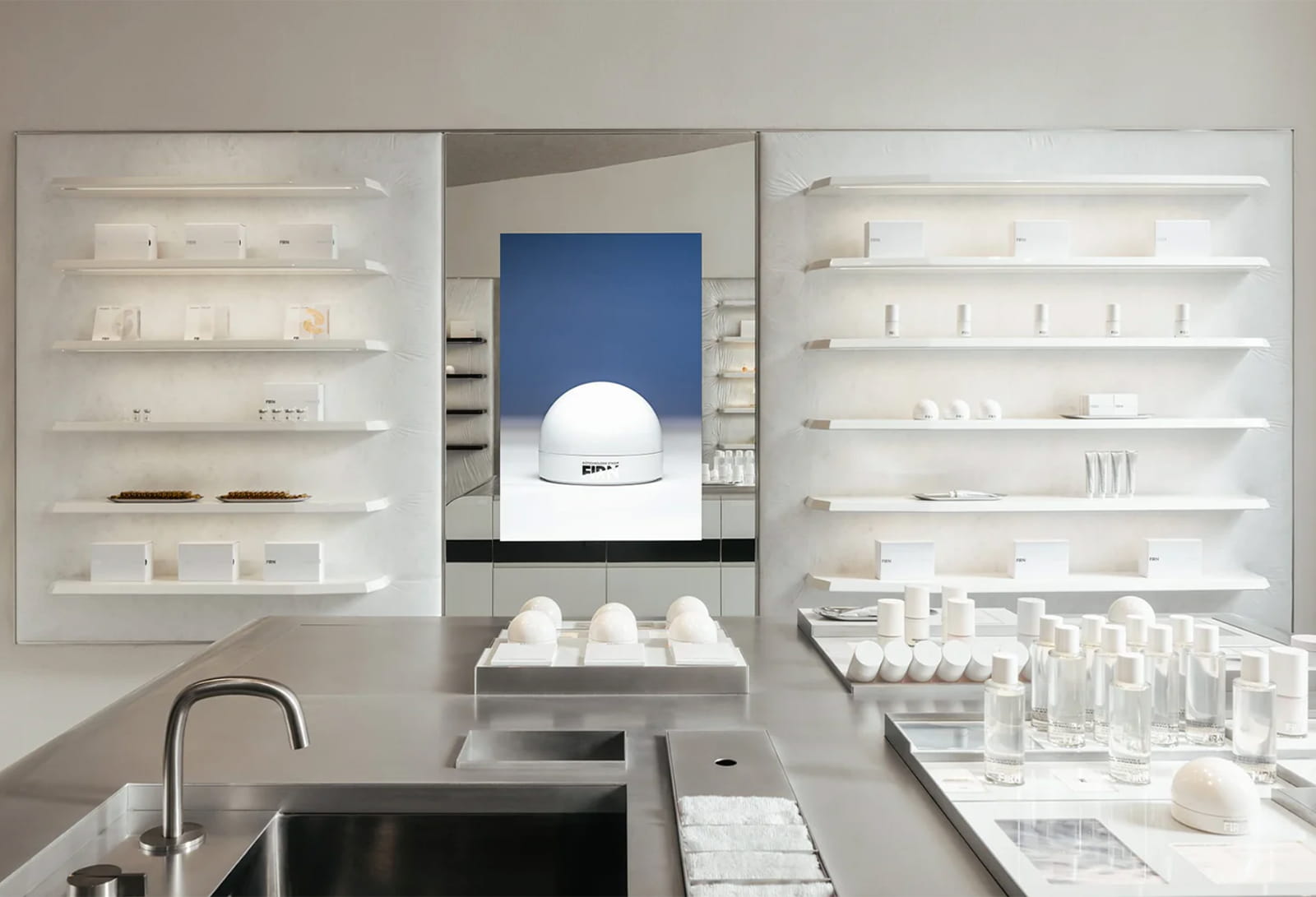
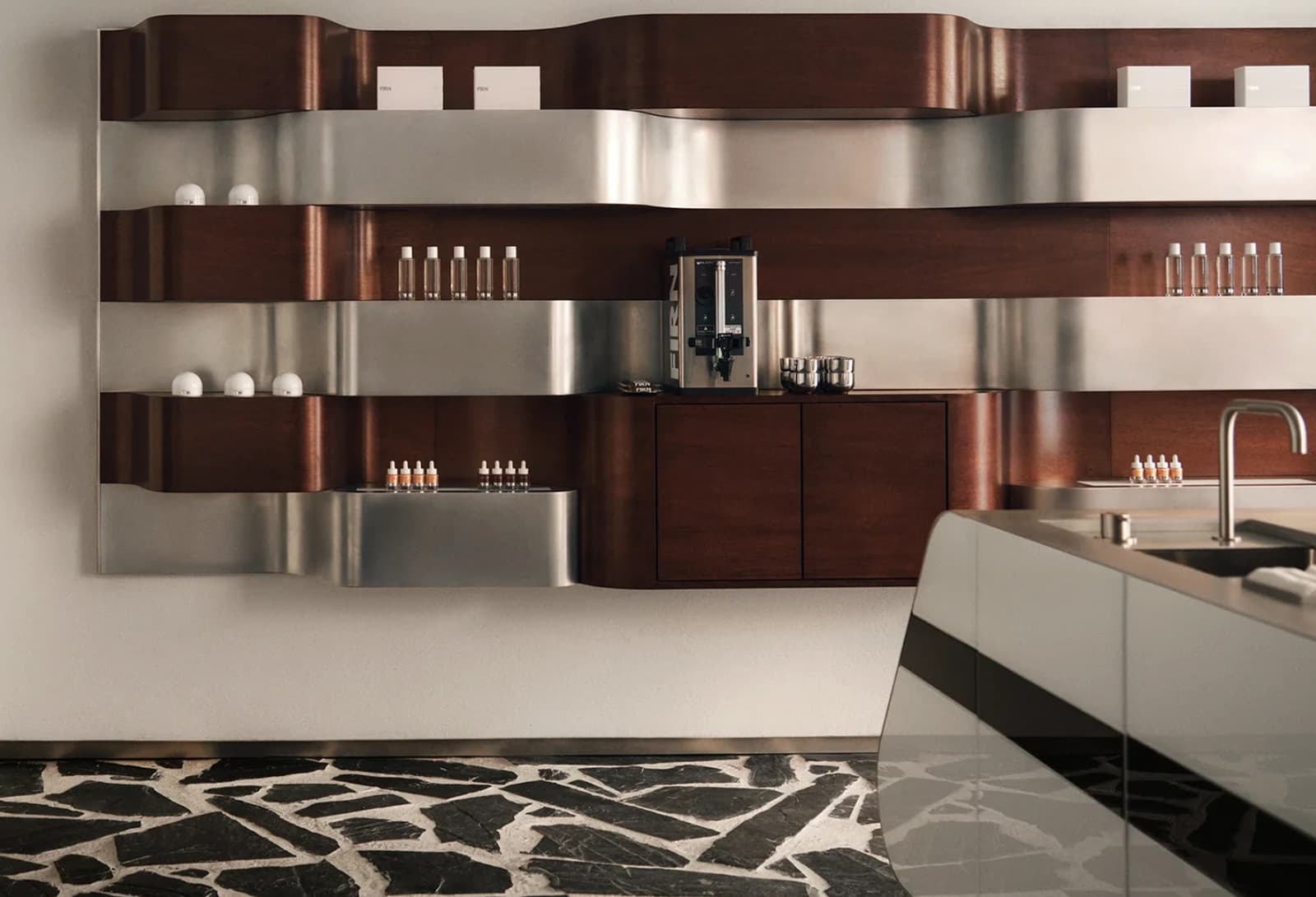
“Our stores really feel like a high-altitude laboratory in the middle of Paris," said Four. Imagined by Rudy Guenaire, founder of interior design firm Studio Nightflight, the most recent store in the historic Marais district alludes to performance and alpine ecosystems in subtle ways. The use of wood and wool gives the space a warm, comforting cabin feeling while creating a sleek, lifestyle environment. Meanwhile, in the first location on pedestrian street Montorgueil, the store is filled with aluminum and glass materials, giving a premium laboratory energy, while the white color palette echoes the alpine elements of the brand.
Each location is meant to transport visitors into the performance-driven world of FIRN, yet they are both very singular in style. “Both stores share a common design vocabulary but are distinctly different. One is more clinical, whiter, and very pure. The other is more lifestyle-oriented, with more wood and a more generous, spacious volume,” she shared.
Nicolas Rebet, retail expert and founder of consultancy Retailoscope, shared his impressions when visiting the Marais location. “There is a very consistent storytelling between the staff and the visual elements, bringing us back to an alpine universe that feels quite premium.” Interestingly, he admitted, “I found the brand experience very qualitative and was quite surprised by the affordable price tags. Brand perception felt very high.”
For reference, the brand’s hero product—a multifunctional moisturizer, which contains peptides and the brand’s trademarked STM30 stem cell complex—retails for €49 ($57). The founders insist that a similar high-performing, technical cream like this would have a much higher price tag, with comparable creams sold for €250+ ($293) on the market.
Owning Distribution for Optimal Brand Storytelling and Experience
Launching and rolling-out a network of stores is undeniably capital-intensive. FIRN has so far not announced any fundraising rounds but did welcome a few angel investors onto its cap table, allowing for the funding of early expansion plans while preserving independence.
For Bostoni, the decision to prioritize owned retail is about maintaining full control. “In physical stores, controlling the narrative and the educational aspect is crucial. We have a sophisticated product, so there are things to explain before purchase. A store network makes that much easier.”
In addition, physical retail captures attention and builds emotional connection like no other channel can. Training their own staff enables optimal brand storytelling but also extends to the overall store experience. “The human touch is what sets brand experiences apart: good service, tailored recommendations, and passionate storytelling are crucial for brands,” explained Rebet.
Rebet is one of many experts who fundamentally believes in the essential, irreplaceable role of physical retail. “Regardless of e-commerce, AI, and what some will say, physical retail will always be relevant. More than 70% of beauty sales in France still happen offline,” he said. Indeed, the French skincare and beauty market largely relies on physical sales channels, including pharmacies—something unique to France—department stores, and beauty retailers including Sephora and Oh My Cream.
While Bostoni admitted his focus is on the Parisian footprint, regional and international expansion is not low on his list of ambitions. “We’re thinking London, Berlin, Milan, maybe New York, and some major regional cities too.”
Beyond retail expansion, the objective is to continuously enhance the store experience to provide a highly unique offering, increasingly centered around longevity. “I don’t see FIRN as a beauty brand. We are more focused on longevity and aging well, so we might go further with diagnostics and more advanced offerings around this theme,” Bostoni shared.
FIRN has created its own playbook, proving that the skincare industry still has room for disruption and white space opportunities. By betting on owned retail over wide distribution, the brand shows that highly immersive, experience-led stores remain a powerful differentiator.

Want to continue reading this article and others just like it?
Subscribe to BeautyMatter and access the most current beauty intelligence and news updates.
SubscribeAlready a member, login here.