Key Takeaways:
Before Pupa Milano burst onto the color cosmetics market in 1975, makeup products all tended to look the same. They shared a certain sophistication that could be seen in everything from the packaging (classic navy or deep green compacts with gold accents) to the products themselves, which favored pale pink lips and classic, cool-toned eyeshadow.
Founded by Angelo Gatti, Pupa Milano brought a colorful, whimsical approach to makeup that instantly resonated with consumers in the mid-to-late-1970s and beyond. Gatti focused just as much on the packaging as he did on the product—a concept that is very much trending in beauty today.
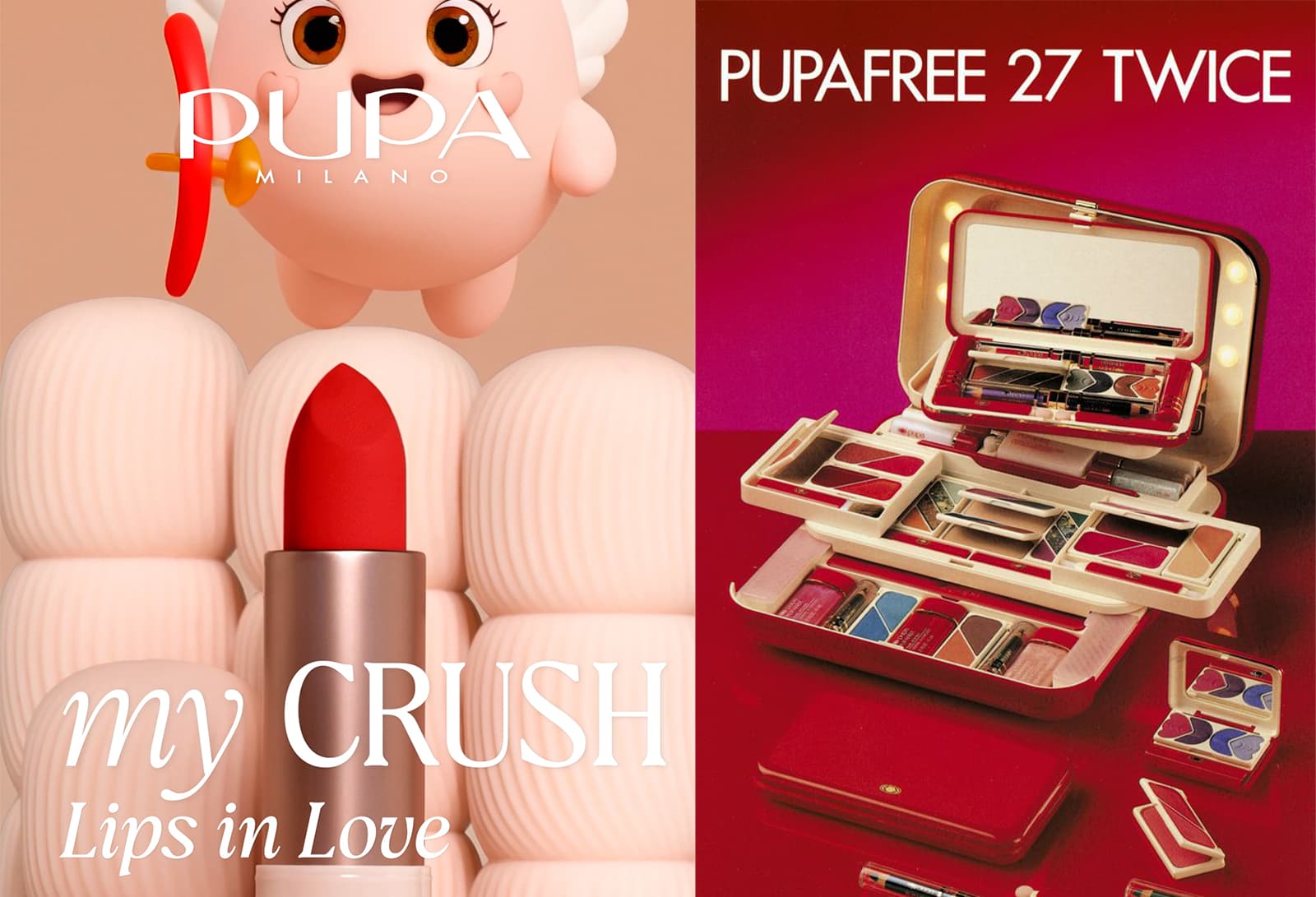
Pupa Milano’s signature red makeup cases were designed with everything one would need to create a full face, including eyes, lips, and face products in a variety of shades, as well as makeup remover to take it all off at the end of the night.
“The ambition was to put together everything a woman would need to get ready, [and] in some cases, not only to apply but also to remove the makeup,” Francesca Comoglio, Chief Marketing Officer at Pupa Milano, told BeautyMatter. “It was a complete beauty set, and the idea was to create something in which the packaging is always complementary and synergic to the product.”
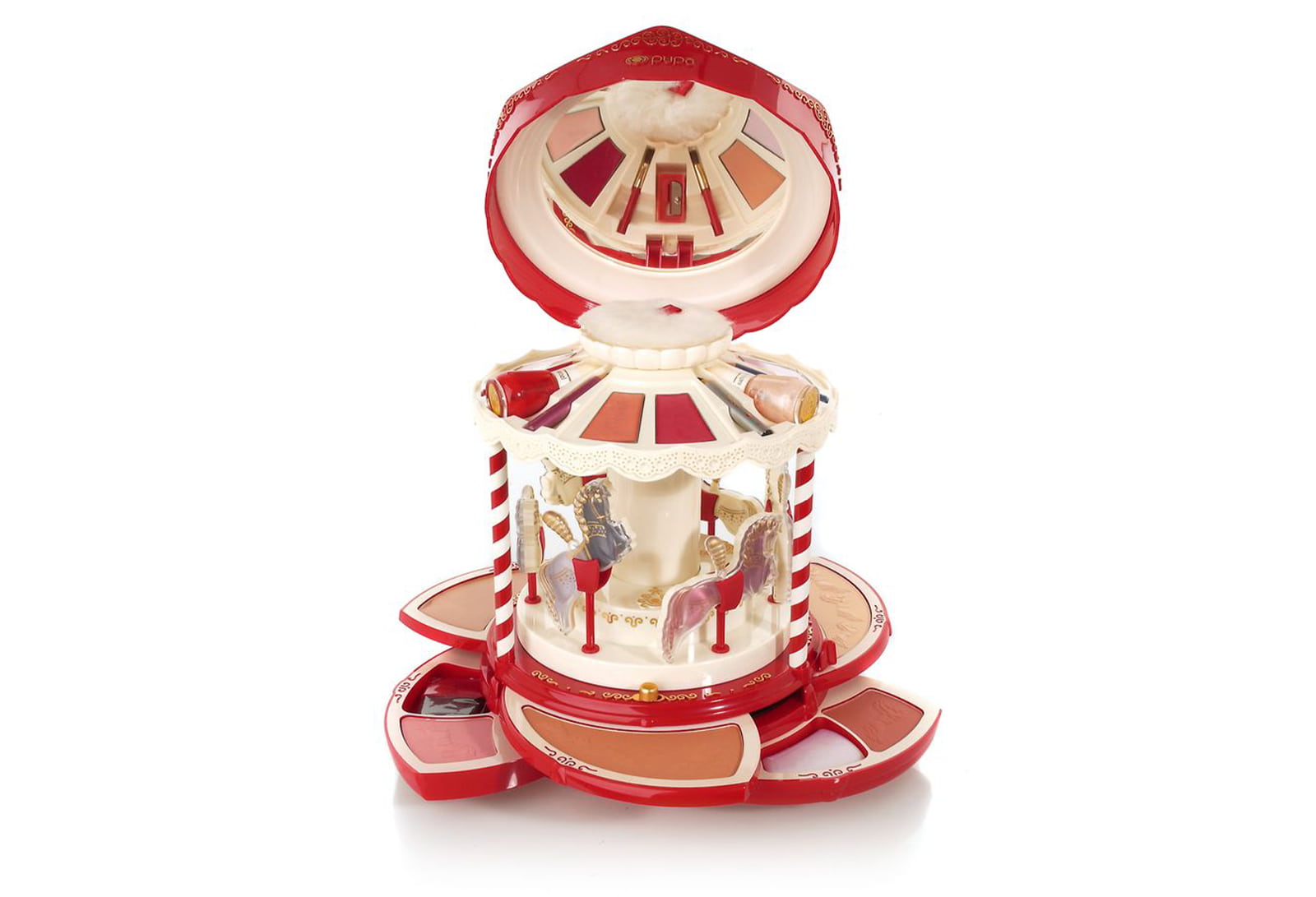
Pupa Milano palettes came in what Comoglio called “fantasy shapes,” with the most famous being an actual working carousel, launched in 1993. The brand’s makeup cases were coveted by Italian and other European girls and young women, frequently selling out soon after launch during the holiday season.
The packaging wasn’t purely decorative; it was also functional. Pupa Milano’s mascara, which was launched in 1975, featured a layered formula with a lash serum at the bottom of the tube to encourage lash growth, as well as a mirror to help women apply the mascara on the go. Another example was the brand’s Bouquet de Parfum, which consisted of three fragrances in separate vials arranged in a bouquet shape. Customers could mix and match the various scents to create a blend that was uniquely theirs, a practice we now call fragrance layering, still very much on trend.
The “Lipification” of Pupa Milano
After over 50 years as one of the most historic and long-standing Italian beauty brands, Pupa Milano continues to push the boundaries of innovation. The brand’s latest launch, My Crush, is a matte lipstick anchored in Pupa Milano’s classic approach to marrying product with packaging. The formula contains a blend of modern emollients, pigments, and powders to create a matte formula without the typical dryness associated with this finish.
Infused with Vita Avocare, an extract derived from “upcycled” Sicilian avocados, My Crush is Pupa Milano’s contribution to the recent “lipification” trend that’s taken the beauty industry by storm.
“We saw a need in the market for a matte lipstick at the next level with no compromise on the comfort of the lips,” Comoglio told BeautyMatter. “[My Crush] features a formula that you can apply with the precision that you need for a matte lipstick, but also with the comfort of a hydrating lipstick.”
Like every Pupa Milano product that came before it, My Crush’s packaging plays just as big a role in the overall experience of the product as what’s inside. In partnership with Berlin Packaging | Cosmei, a pioneer in silicone beauty packaging, Pupa Milano’s design team developed a special silicone cover that evokes the matte finish of My Crush. Together, the smooth matte formula and velvety silicone outer packaging create a sensory and tactile experience that makes the act of application feel as luxurious as the finish.
“We wanted something that immediately evoked the exceptional softness of the matte lipstick itself and the instinctive desire to touch the product,” said Comoglio. “The same sensoriality in the application is also present in the packaging.”
While Pupa Milano has expanded into other categories (such as complexion, bodycare, and fragrance) over its 50-year history, color—and more specifically, lips and eyes—has always been at the core of the brand. Recent launches across Europe suggest a movement toward matte and semi-matte finishes, reflecting consumers' desire for color that carries impact while remaining comfortable on the lips. Pupa Milano’s My Crush represents the brand’s early move to capitalize on this emerging “matte movement” ahead of its mainstream adoption.
“Lipstick—particularly matte lipstick—is the emblem of makeup and beauty,” said Comoglio. “It's a must-have product when we talk about a makeup brand, so we wanted to play with something iconic and make it very Pupa.”
My Crush’s “skinified” formula, as Comoglio put it, is a love letter to Italy as much as it is to color cosmetics. The Italian beauty brand collaborated with Intercos for formula and product development, Berlin Packaging | Cosmei to design the innovative packaging, and Spring Studios Milano to create the campaign for the launch—three powerhouse Italian companies whose craftsmanship and expertise underpin why “Made in Italy” has become synonymous with quality, design, and manufacturing excellence in beauty.
“It takes teamwork to bring something like My Crush to life, and Mr. Gatti is great at bringing out the best in people, and that’s how the magic happens,” said Comoglio. “The Pupa Milano team couldn’t have done without the help of our partners, Intercos, Berlin [Packaging] Cosmei, and Spring Studios, who came together to take what was once just an idea and transform it into reality.”
My Crush Comes to Life
The visual campaign, created in collaboration with Spring Studios, aimed to capture the unmistakable bond between a woman and her lipstick, which was underscored by the tagline “Lips in Love.” The creative team conceptualized a CGI character as a sort of mascot for the launch, which they named Cupidino. Blending live action, AI, and CGI, the My Crush campaign is a visual love story of lipstick.
“The [Lips in Love] campaign carries a strong message also of self-love and self-indulgence,” said Comoglio. “The idea was not to create something that positioned lipstick as a tool to seduce someone else, but rather to create something empowering for yourself.”
My Crush comes in 15 shades: five nudes, five pinks, and five reds. It’s priced at €23.90 ($28), which is higher than a brand like Kiko Milano but below luxury designer labels such as Gucci Beauty and Dolce & Gabbana. This price point is in keeping with Pupa Milano’s masstige position in the market, which it has maintained throughout the company’s 50-year history. According to Comoglio, Pupa Milano has always prioritized delivering high-quality products at strong value. This has become even more important in today’s beauty landscape.
“This is the first time in history that the beauty market has been this crowded, with such a wide disparity in price points, from super low to super high,” she said. “Pupa Milano’s strength has been its ability to stay agile, adapt to constant market changes, and remain strong over the past 50 years.”
This year, Pupa Milano plans to expand the shade range and introduce a Labubu-style gift-with-purchase featuring Cupidino, the My Crush mascot. Comoglio sees the My Crush line as the brand’s next hero franchise. If Pupa Milano palettes put the brand on the map, My Crush is going to keep it there in 2026 and beyond.
“Pupa Milano is very much associated with color, especially with the success of our palettes, so we want to keep building on that," said Comoglio.
One thing that hasn’t changed is the creative vision behind the company. Gatti, now in his 80s, continues to serve as President of Pupa Milano, while his son, Valerio Gatti, leads the company as CEO. As a second-generation family business, Pupa Milano has weathered market shifts while remaining anchored in its core pillars of creativity, innovation, and color expertise. While other legacy fashion and beauty brands may bring on new creative directors every few years, Pupa Milano sees Gatti’s legacy of innovation as a major advantage.
“When you have the founder involved in the company for 50 years, you preserve the brand’s identity and ensure it can stay true to itself in a way few others can,” said Comoglio.
In 2024, Pupa Milano generated €100 million ($116 million) in revenue across 70 countries. The brand has a direct presence in Italy, where it is headquartered in Casatenovo, as well as a branch in Paris and more than 36 monobrand boutiques across Slovakia, Romania, and Hungary. Pupa Milano’s internal team comprises around 380 employees and manages all in-house activities related to development, design, creativity, and communication.
When asked whether the Gatti family has any plans to sell the company to a major European beauty conglomerate, Comoglio said there is “no interest” in a sale of any kind. For now, Pupa Milano is focused on growth in its main markets—Italy, France, Slovakia, Romania, and Hungary—as well as Germany, Switzerland, and Austria. While the brand isn’t available in the US, Comoglio said that it’s something the company would like to pursue in the future.
What carried Pupa Milano through the last 50 years is also what consumers connect with most today: a focus on quality, creativity, and innovation. With the visionary Gatti at the helm, and in partnership with the best creative and design firms that Italy has to offer, Pupa Milano is poised for another half-century of growth and expansion.
As Comoglio put it, “Pupa Milano is one of the few brands with such a long, rich history, and it carries that heritage with it at every step of its journey around the world.”